2026 Career Pivots Earnest Research Report
The Real Price of Reinvention
We love to talk about career changes like they're acts of self-actualization. The data says a lot of them start with someone losing their job and trying not to financially drown.
Authors:
Joseph Kim, opens in a new tab, Lead Researcher at Earnest
Kaydee Ambas, opens in a new tab, Certified Financial Education Instructor℠ at Earnest
Methodology
Before the leap. And after.
We wanted to know what it actually costs to change careers—not just the tuition and the certifications, but the real financial toll: the lost income, the debt, the time it takes to feel financially normal again. And we wanted to know whether people planning a change have any idea what they're actually signing up for.
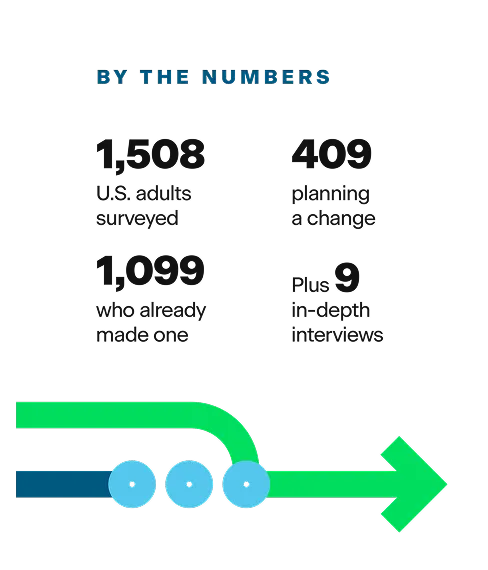
So we asked both groups. We surveyed 1,508 U.S. adults, oversampling people who've either changed careers or seriously thought about it. Some of them (409) are still weighing the decision or partway through it—we asked what they expect. The rest (1,099) already made the leap—we asked what actually happened. Putting those two groups side by side is what let us find the gap between the story people tell themselves going in and what they report coming out the other side.
We also sat down with 9 people for longer, in-depth conversations—about 30 minutes each—to hear the parts a survey can't really capture: what it felt like, what surprised them, what they'd do differently.
Who we talked to
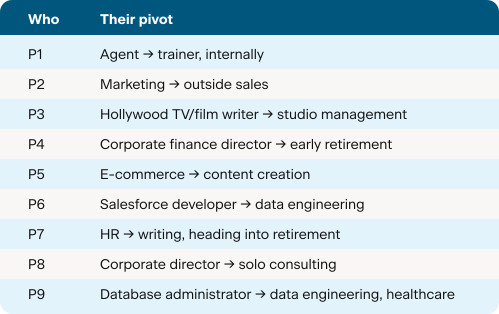
We're using initials below to protect their privacy, but here's who they are, so they're not just a letter and a number when they show up later in this report. The first five had already made their change when we talked to them; the last four were still in the middle of it.
All data is anonymized and aggregated. Participants were compensated for their time. Full methodology, significance testing, and raw data tables are available in the appendix.

Foreword
The story we tell ourselves
We spend an enormous part of our lives working. So maybe it shouldn't be surprising that somewhere along the way, ‘what do you do?’ became shorthand for ‘who are you?’
Even our fantasies about escaping work usually involve… different work. We don't realistically dream about getting out of the rat race. We dream about becoming a happier rat: a career that fulfills us, pays us more, leaves us enough time to actually enjoy our lives, and maybe even makes us excited to answer the dreaded “So, what do you do?” at a party.
Enter the career pivot. We've romanticized changing careers into an act of reinvention: the brave leap into something better. More money. More flexibility. More meaning. A chance to take control of your life and become the person you were supposed to be all along.
"I wasn't sure what it would be like when that's gone... who am I? What am I gonna be if I'm not that finance person anymore?"
Foreword
The story we tell ourselves
We spend an enormous part of our lives working. So maybe it shouldn't be surprising that somewhere along the way, ‘what do you do?’ became shorthand for ‘who are you?’
Even our fantasies about escaping work usually involve… different work. We don't realistically dream about getting out of the rat race. We dream about becoming a happier rat: a career that fulfills us, pays us more, leaves us enough time to actually enjoy our lives, and maybe even makes us excited to answer the dreaded “So, what do you do?” at a party.
Enter the career pivot. We've romanticized changing careers into an act of reinvention: the brave leap into something better. More money. More flexibility. More meaning. A chance to take control of your life and become the person you were supposed to be all along.
Sometimes it is. But have you looked at the job market lately? Hiring has slowed to a crawl. The US added an average of just 34,000 jobs per month, opens in a new tab over the past year, and nearly 7 million Americans are unemployed. Plus, AI is looming over all of this: the Bureau of Labor Statistics, opens in a new tab expects it to reshape work across a range of occupations, even as exactly what that means for our jobs remains uncertain.
So sometimes you bravely choose reinvention, but sometimes you just get laid off. And reinvention is a hell of a lot easier to romanticize when you're still getting a paycheck. Once the paycheck stops, a career change becomes something else too: a financial endurance test.
Most people aren't exactly entering this period with a meticulously engineered financial plan. They make their best guess about how much they'll need, how long the transition will take, and how quickly they'll bounce back. As it turns out, we're a pretty optimistic bunch.
People going into a career change tend to underestimate the financial toll—especially how long they might be without a full paycheck. The people who've already lived through one tell a much messier story: savings get depleted, debt happens, timelines stretch, and feeling financially “normal” again can take much longer than expected.
And yet, most people are still glad they did it. That's what makes this story more complicated than “career changes are expensive.” People are taking real financial hits in pursuit of lives they hope will fit them better. Sometimes they're jumping, sometimes they're pushed. Either way, most of them arrive on the other side happier than they were before.
At Earnest, we wanted to understand what happens in between: what people actually spend, what they lose, how they pay for it, and what they wish they'd known before they made the leap.
Because the biggest financial risk of changing careers isn't always what you'll spend getting there. It's what happens while you're in between.

"I wasn't sure what it would be like when that's gone... who am I? What am I gonna be if I'm not that finance person anymore?"
Key takeaways
Why people actually leave
“Better work-life balance” sounds nicer than “I lost my job.”
Before we get into what a career change costs, it’s worth asking why people actually make one in the first place. Most career-change advice assumes everyone's story looks like a choice: people make the change for better balance, more money, or to finally pursue a passion. For some people that’s true, but for a lot of people it’s not.
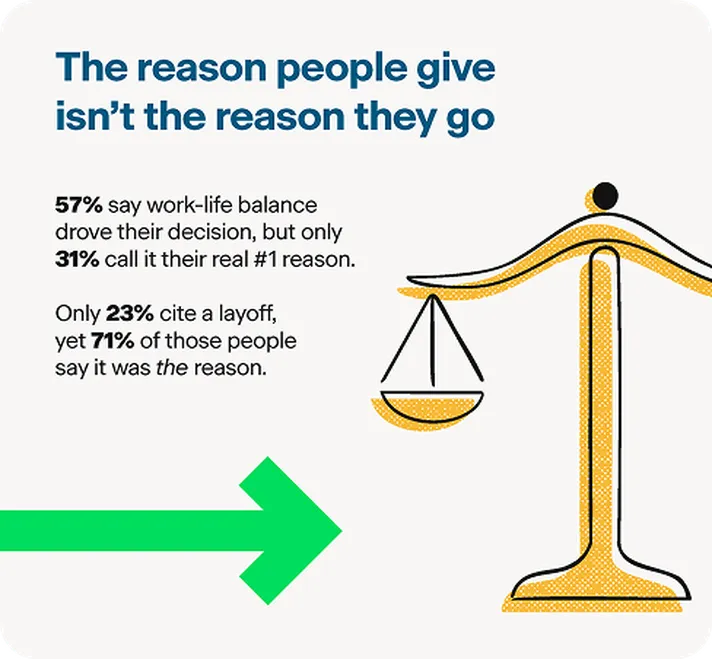
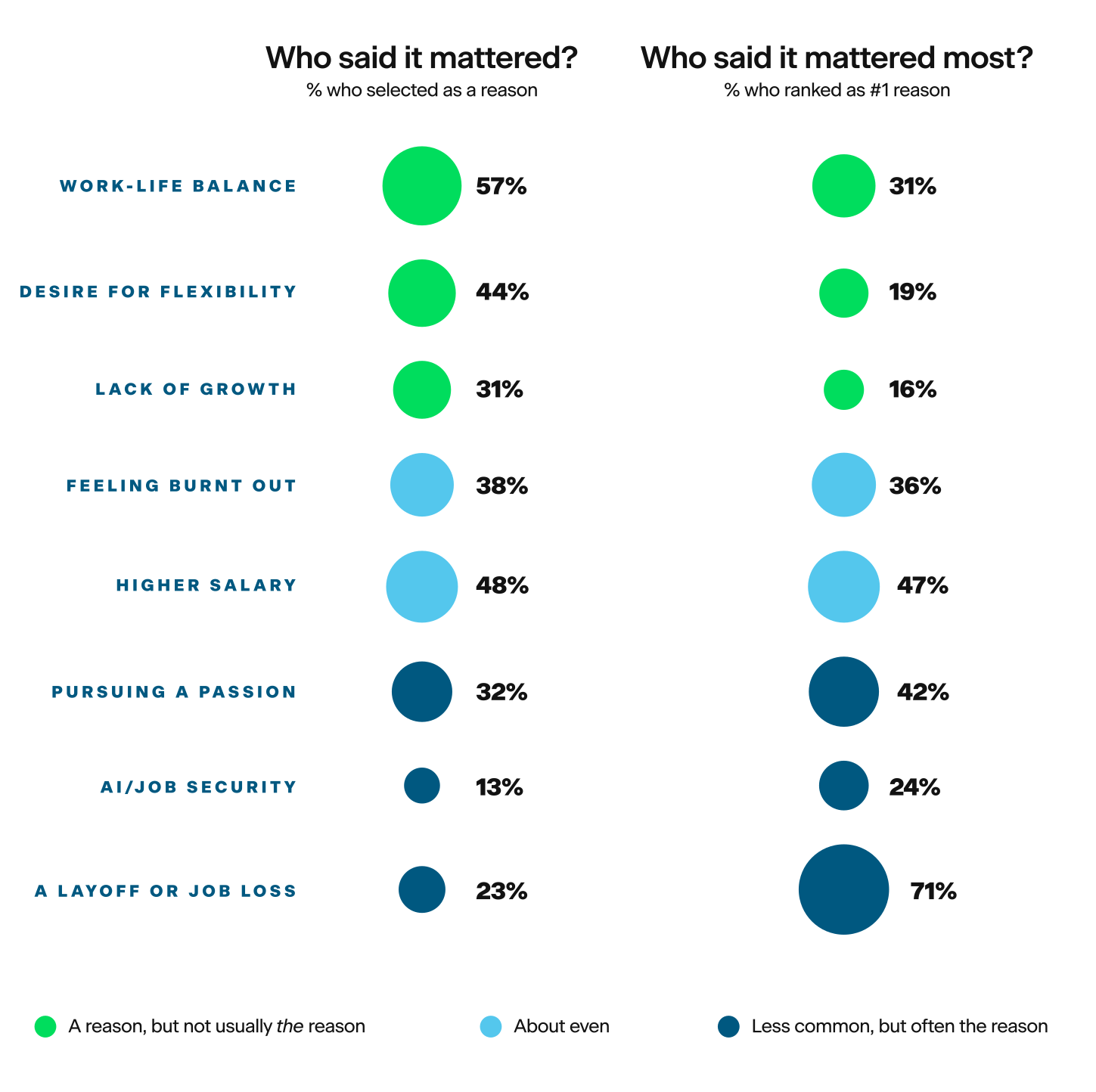
Our survey backs this up in a way that's easy to miss if you only look at the topline. Ask people why they're changing careers and 57% say it’s for work-life balance. People select that reason more than salary, more than flexibility, more than burnout itself. It's the story people reach for first.

Why people actually leave
“Better work-life balance” sounds nicer than “I lost my job.”
Before we get into what a career change costs, it’s worth asking why people actually make one in the first place. Most career-change advice assumes everyone's story looks like a choice: people make the change for better balance, more money, or to finally pursue a passion. For some people that’s true, but for a lot of people it’s not.
Our survey backs this up in a way that's easy to miss if you only look at the topline. Ask people why they're changing careers and 57% say it’s for work-life balance. People select that reason more than salary, more than flexibility, more than burnout itself. It's the story people reach for first.
But ask them to name the one reason that actually pushed them out the door, and the story flips. A layoff is the most likely reason to be someone's real #1—71% of the people who cite it rank it first, by far the strongest conviction of any motivator we asked about. Work-life balance, the most popular answer, is the top reason for only 3 in 10 of the people who claim it.
AI follows the same pattern in miniature. Only 13% select AI or job security as a reason at all, but when they do select it, 24% rank it their #1 reason—nearly twice the rate you'd expect from the selection number alone.
Work-life balance is the reason people are proud to give, but a layoff is the reason most people are actually working with. Keep that in mind for what's ahead—a lot of the financial decisions in this report started as something nobody chose in the first place.
"It was out of my control: my industry is being taken over by AI and experienced mass layoffs. My degree and 15-year background is near-worthless now. There are so few jobs for so many people laid off. I have no idea what to do at this point."
The reason people give vs. the reason that actually pushed them
Source: Earnest Research 2026; Base: National survey, U.S. adults 18+ who have changed or are considering changing careers (n=1,508), plus 9 in-depth qualitative interviews. Q4/Q5, asked of all respondents (n=1,508).
The gap is the cost
Not getting paid is very expensive
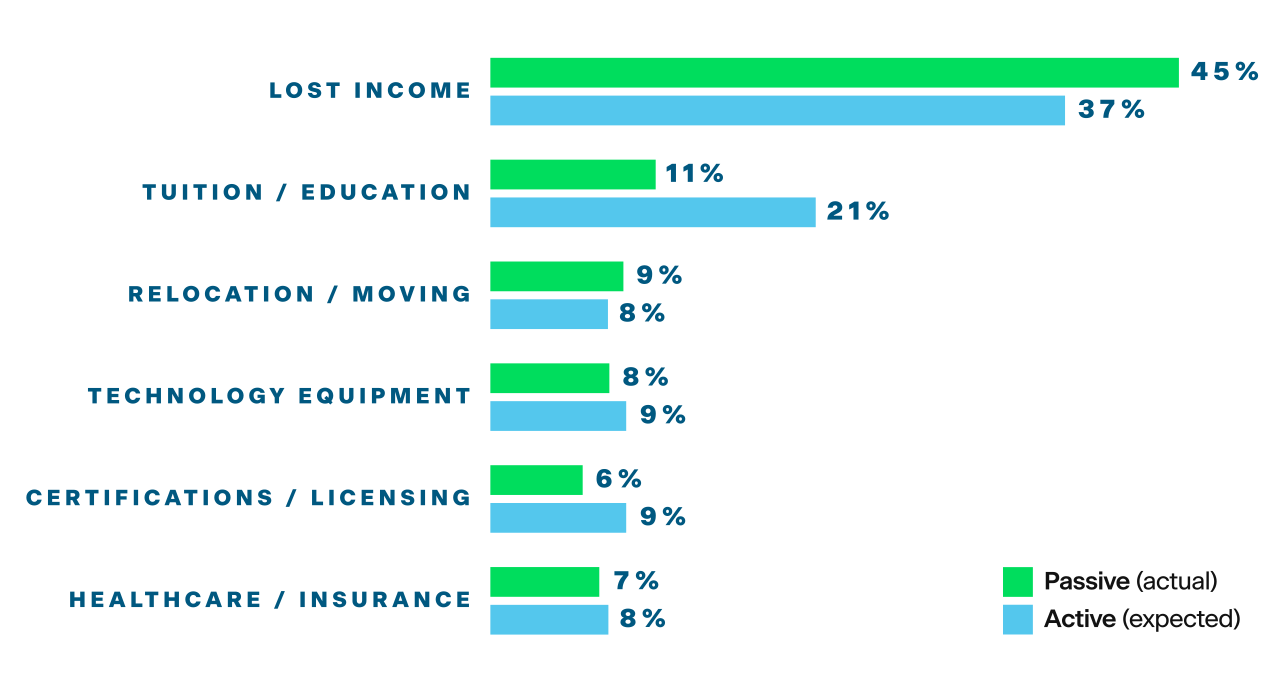
Ask someone what a career change costs and they'll picture a bootcamp fee, a certification, maybe a new laptop. That's not where the money actually goes. Across everyone we talked to and surveyed, the real cost is simpler and harder to plan for: going without a paycheck during the transitional period.
P2 (marketing → outside sales) did this about as carefully as it can be done. Before leaving marketing for outside sales, he lined up a three-month runway—about $15,000 from savings, plus a little tutoring income to soften it. He still describes it as tight. Rent alone ate most of the budget every month. But he could see the other side of it. He knew, roughly, when it would end.

The gap is the cost
Not getting paid is very expensive
Ask someone what a career change costs and they'll picture a bootcamp fee, a certification, maybe a new laptop. That's not where the money actually goes. Across everyone we talked to and surveyed, the real cost is simpler and harder to plan for: going without a paycheck during the transitional period.
P2 (marketing → outside sales) did this about as carefully as it can be done. Before leaving marketing for outside sales, he lined up a three-month runway—about $15,000 from savings, plus a little tutoring income to soften it. He still describes it as tight. Rent alone ate most of the budget every month. But he could see the other side of it. He knew, roughly, when it would end.
One survey respondent didn't get that. No runway, no three-month plan—just a smaller paycheck starting immediately, after the job market in their field dried up: "I had to get a much lower paying job in another industry in order to find some work." On paper, both of them lost income. That's where the similarity ends. P2 built a bridge and walked across it on a schedule he set. The survey respondent got a demotion with no end date on it.
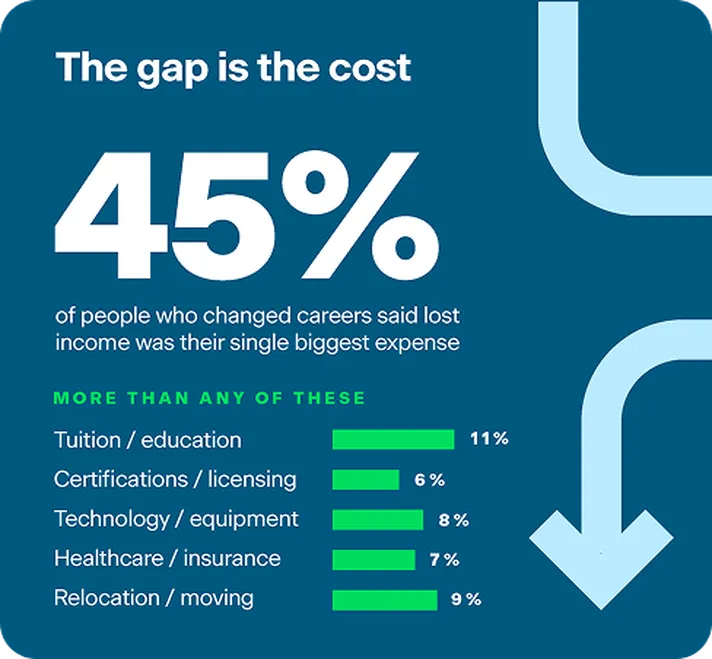
The survey backs up what these two stories suggest: 45% of people who've already changed careers say lost income was their single biggest expense—more than tuition, certifications, technology, or relocation—and it’s not close. It's also the most surprising cost, in people's own words. When we asked what caught them off guard, the answer usually wasn't a bill they didn't see coming. It was how long the bills kept coming with no paycheck behind them.
"The loss of income in between projects cost me part of my savings account."
The single most costly expense of changing careers
Source: Earnest Research 2026; Base: National survey, U.S. adults 18+ who have changed or are considering changing careers (n=1,508), plus 9 in-depth qualitative interviews. Q8 (Active n=409, Passive n=1,099).
How people actually prepare
Almost everyone wishes they’d done more
P2 (marketing → outside sales) built his three-month runway on a number he picked up from research online—a rule of thumb, not a calculation. Looking back, he thinks it should have been six. P7 (HR → writing/retirement) has something similar but starker: "about six months before I hit zero," in her words—which is really a countdown, not a budget.
That's most people. Only two people we talked to did anything resembling formal planning. P4 (corporate finance director → early retirement) worked with a financial advisor who ran her decision through thousands of scenarios; in 99% of them, her plan held up, and that was enough to convince her to make the jump. P8 (corporate director → solo consulting) built out a real spreadsheet—401(k), HSA, self-employment tax tradeoffs—backed by roughly $200,000 in stock from a prior employer's IPO.

How people actually prepare
Almost everyone wishes they’d done more
P2 (marketing → outside sales) built his three-month runway on a number he picked up from research online—a rule of thumb, not a calculation. Looking back, he thinks it should have been six. P7 (HR → writing/retirement) has something similar but starker: "about six months before I hit zero," in her words—which is really a countdown, not a budget.
That's most people. Only two people we talked to did anything resembling formal planning. P4 (corporate finance director → early retirement) worked with a financial advisor who ran her decision through thousands of scenarios; in 99% of them, her plan held up, and that was enough to convince her to make the jump. P8 (corporate director → solo consulting) built out a real spreadsheet—401(k), HSA, self-employment tax tradeoffs—backed by roughly $200,000 in stock from a prior employer's IPO.
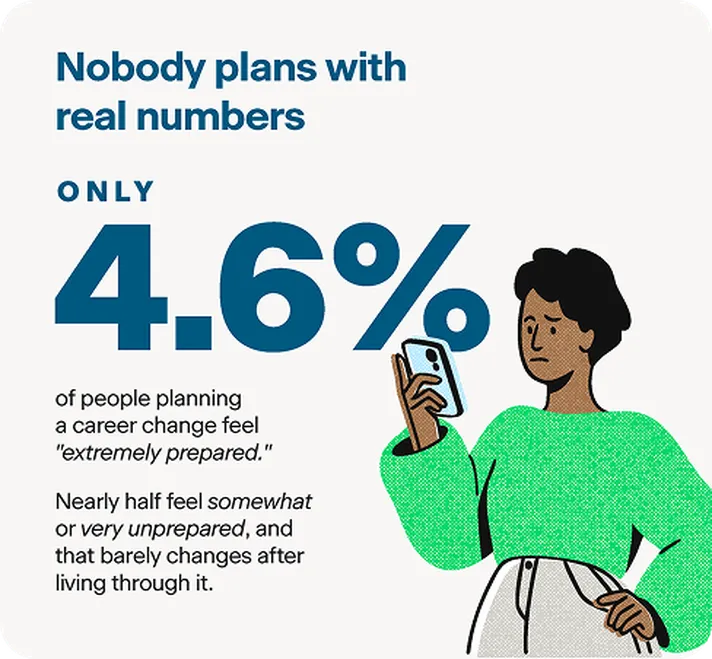
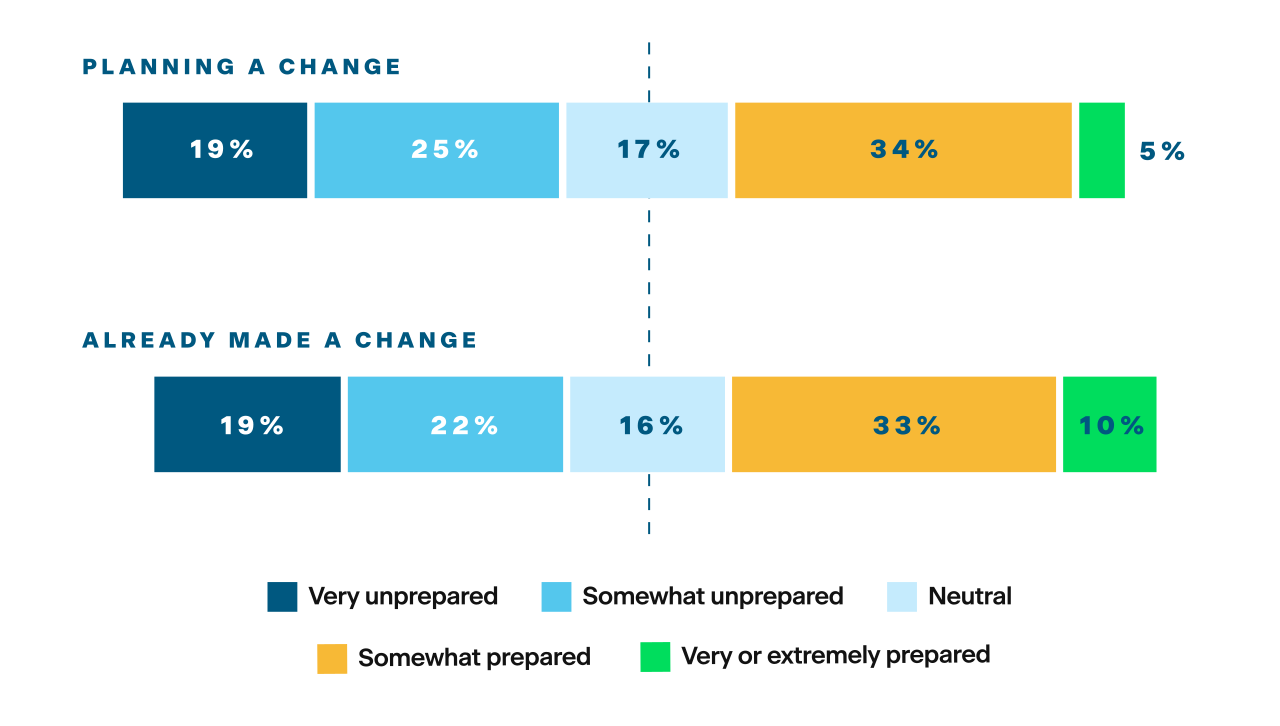
The other seven didn't do that. Most people don't, and the survey backs it up: only 4.6% of people currently planning a career change say they feel "extremely prepared." Nearly half land in "somewhat" or "very" unprepared.
"I wish I had thought and looked into my health insurance costs and childcare costs."
How prepared people feel: Planning a change vs. having already made one
Source: Earnest Research 2026; Base: National survey, U.S. adults 18+ who have changed or are considering changing careers (n=1,508), plus 9 in-depth qualitative interviews. Financial preparedness prior to transition—Active (n=409) and Passive (n=1,099).
The perspective doesn't really change once people are on the other side of it. Looking back, people don't usually say they wish they'd spent less, or chosen a cheaper program. They wish they'd looked further ahead at the stuff that doesn't show up on a checklist:
Nobody in these interviews was asking "what's the ROI of this move?" They were asking, “How long can I survive?” That's probably the better question. A career-change budget can tell you what tuition costs. A runway tells you how long you can keep paying rent, healthcare, childcare, groceries, and everything else if the next paycheck takes longer than expected.
The people who planned for the gap gave themselves something more valuable than a perfect forecast: time.
"I wish I would have researched more on the cost of relocating my family. I have kids so their lives changed as well."
The optimism gap
Career-change expectations, meet career-change reality
Most research on career changes is a single snapshot, asking people how they feel about a decision at one point in time. We asked two different groups the same questions from opposite sides of the decision—people about to change careers, and people who already had—so we could put their answers side by side and measure the gap directly.
On nearly every parallel question, what people expect going in and what people actually experience coming out are statistically different. And not by a rounding error, but by a wide, significant margin.

The optimism gap
Career-change expectations, meet career-change reality
Most research on career changes is a single snapshot, asking people how they feel about a decision at one point in time. We asked two different groups the same questions from opposite sides of the decision—people about to change careers, and people who already had—so we could put their answers side by side and measure the gap directly.
On nearly every parallel question, what people expect going in and what people actually experience coming out are statistically different. And not by a rounding error, but by a wide, significant margin.
What active planners get vs. what passive changers experience
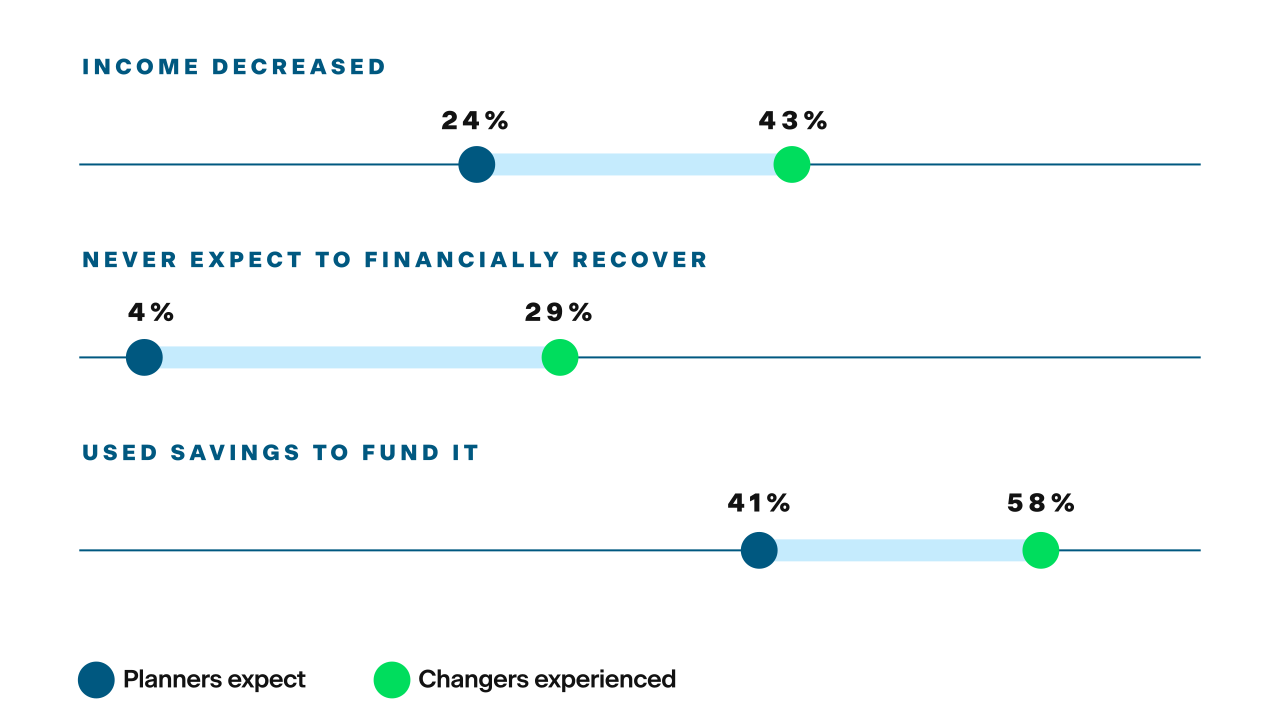
Source: Earnest Research 2026; Base: National survey, U.S. adults 18+ who have changed or are considering changing careers (n=1,508), plus 9 in-depth qualitative interviews.
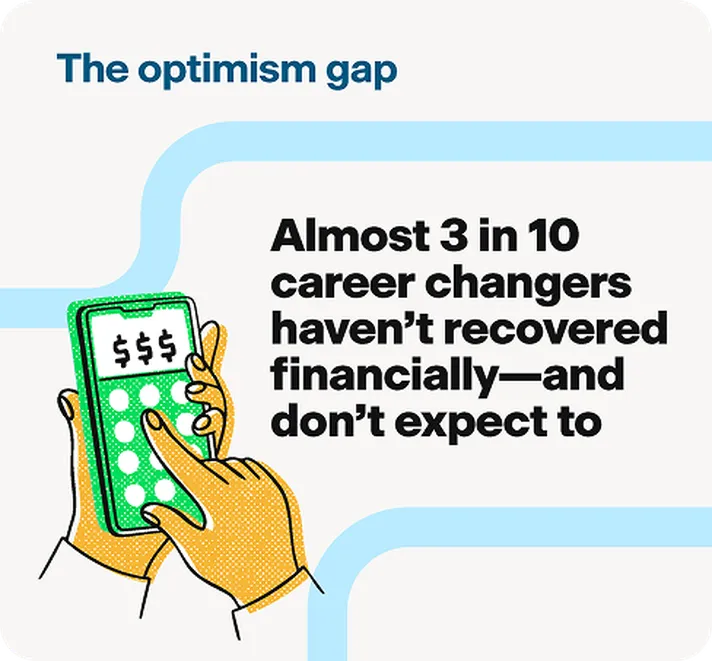
The starkest gap is on recovery. Only 3.9% of people currently planning a change expect to never financially recover from it. Among people who've already made the change, 29.4% say they haven't recovered and don't expect to. That's not a small miss—it's roughly a 7x gap between the story people tell themselves before they jump and what they report once they've landed.
The gap isn't only about outcomes—it also shows up in what people are actually afraid of. We asked both groups what the hardest part of changing careers is (or was). Almost every fear people report going in turns out to be less universal than they expected once they're on the other side of it.
Almost every fear fades. Two don't.
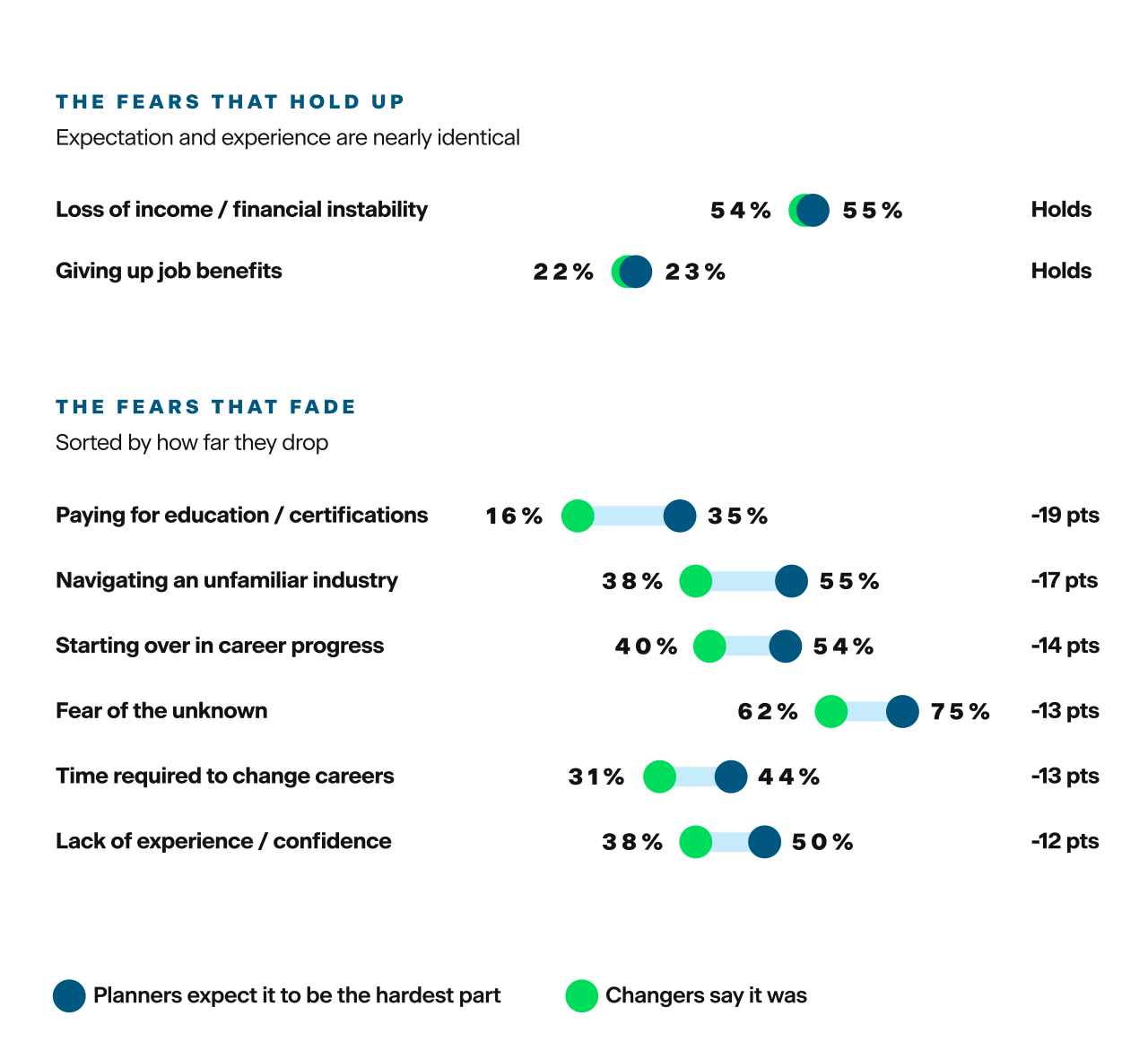
Source: Earnest Research 2026; Base: National survey, U.S. adults 18+ who have changed or are considering changing careers (n=1,508), plus 9 in-depth qualitative interviews.
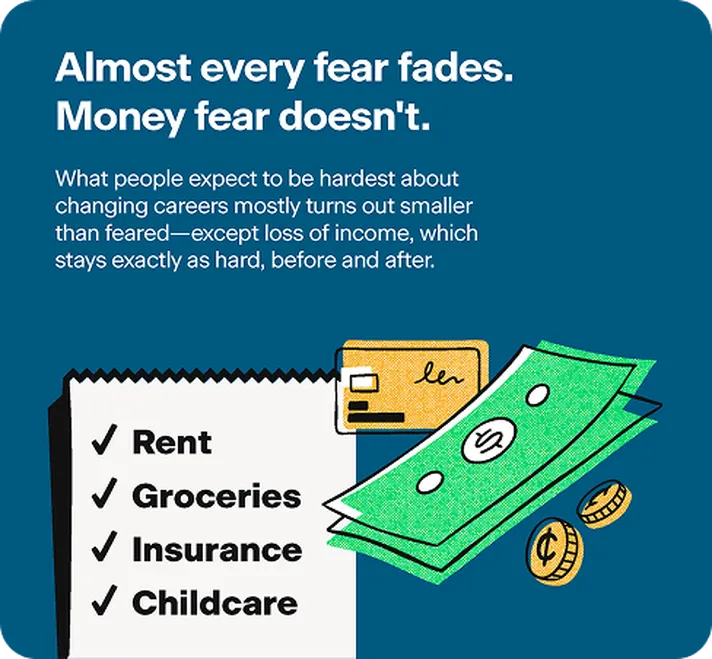
Fear of the unknown drops from 75% to 62%. Navigating an unfamiliar industry drops from 55% to 38%. Paying for education drops hardest of all, from 35% to just 16%. So the thing people worry about most before they've priced it out turns out to be one of the easiest to actually live with.
Two things don't fade at all: loss of income sits at 55% for planners and 54% for people who've already been through it. Giving up job benefits also barely moves. Almost everything else about a career change turns out to be more survivable than people fear. The money doesn't.
People are afraid of the wrong things, but they're afraid of the right thing too. It's just buried under a longer list of fears that mostly turn out to be smaller than expected.
"I also wish I had been more confident in transferring my existing skills instead of assuming I had to completely start over. Many skills like communication, problem-solving, and leadership carried over more than expected."
How people actually pay for it
First the savings disappear, then the credit card comes out
There's a clear financing hierarchy across everyone we talked to and surveyed: draw down savings first, cut spending hard second, and take on debt only when the first two options run out. 58% of people who changed careers used savings to fund it. Only 36% took on new debt at all, and even then, credit cards—not personal loans or structured financing—were the most common tool, used by 66% of borrowers.

How people actually pay for it
First the savings disappear, then the credit card comes out
There's a clear financing hierarchy across everyone we talked to and surveyed: draw down savings first, cut spending hard second, and take on debt only when the first two options run out. 58% of people who changed careers used savings to fund it. Only 36% took on new debt at all, and even then, credit cards—not personal loans or structured financing—were the most common tool, used by 66% of borrowers.

What's more interesting than the hierarchy is what people do with the debt they can't avoid. Nobody in our interviews described it as a normal financial tool. Everyone had a way of making it feel like something else.
P1(Agent → trainer) put a couple hundred dollars of training on a credit card and a small personal loan, paid it off, and focused on the fact that their credit score went up. P2 took on about $3,000 during his three-month gap and called it "a necessary burden… like a car loan"—a specific, justifiable amount for a specific reason, not open-ended spending. P5 (E-commerce → content creation), who took on the most debt of anyone we spoke with, described having to consciously reframe it as "investing in yourself" so it didn't feel like "stupid spending."
Different amounts, different stories, same underlying move: debt only becomes acceptable once it's been translated into something that isn't quite debt—an investment, a car payment, a closed chapter. This is a population that treats debt as a pressure valve, not a plan.
What people are really managing isn't their balance—it's how the balance makes them feel. That's a strange thing to be this careful about if money were the only thing at stake. The financial reframing in this section is a preview of something bigger: a lot of what's actually hard about changing careers has nothing to do with money at all.
"The goal is being debt-free… avoiding taking another debt to add on. So the idea is the saving part of it, it's not yet the debt."
"I don't intend to take any loans out for the consulting transition."
The emotional bill
People start to feel guilty for enjoying their lives
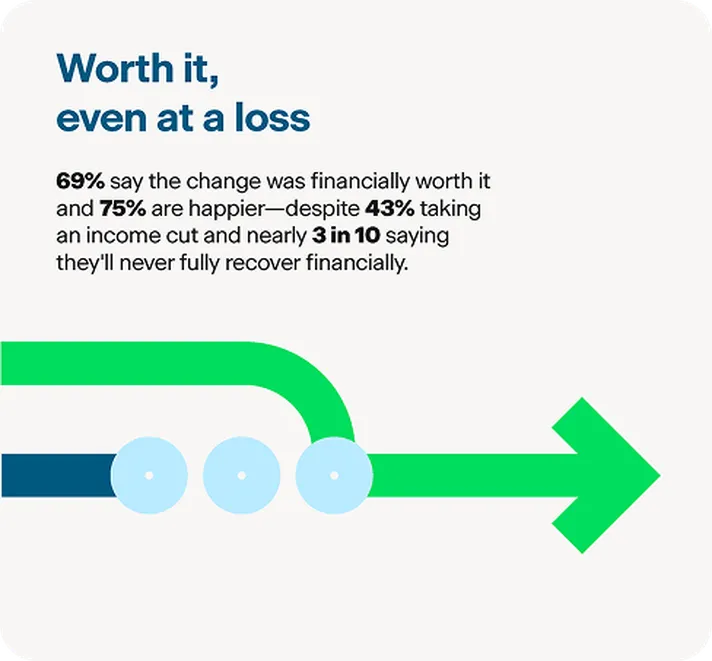
When we asked people who'd changed careers whether it was worth it, the answers almost never started with money. 69% say the change was financially worth it, and 75% say they're happier—despite 43% reporting an income decrease and 29% saying they haven't recovered and don't expect to. Financial pain and genuine satisfaction aren't opposites here. They coexist, for most people, at the same time.

The emotional bill
People start to feel guilty for enjoying their lives
When we asked people who'd changed careers whether it was worth it, the answers almost never started with money. 69% say the change was financially worth it, and 75% say they're happier—despite 43% reporting an income decrease and 29% saying they haven't recovered and don't expect to. Financial pain and genuine satisfaction aren't opposites here. They coexist, for most people, at the same time.
That's the paradox P3's quote makes concrete: the money was tight, but that's not what actually got to her. It was smaller than that—the guilt of still wanting to spend on the things that make life feel like life, at a moment when spending anything felt like it needed defending.
The survey shows that guilt is common, not personal. Emotional toll is the second most underestimated cost of changing careers (47%), behind only time without income itself (53%)—ahead of the cost of training, certifications, or relocation, the expenses people usually warn each other about.
We've run research on money and relationships before—last year's Debt & Dating report, opens in a new tab found people would rather discuss politics on a first date than their credit card balance. Even against that bar, this topic surprised us. People got more emotional talking about a career change than they did talking about love.
What people underestimate most about changing careers
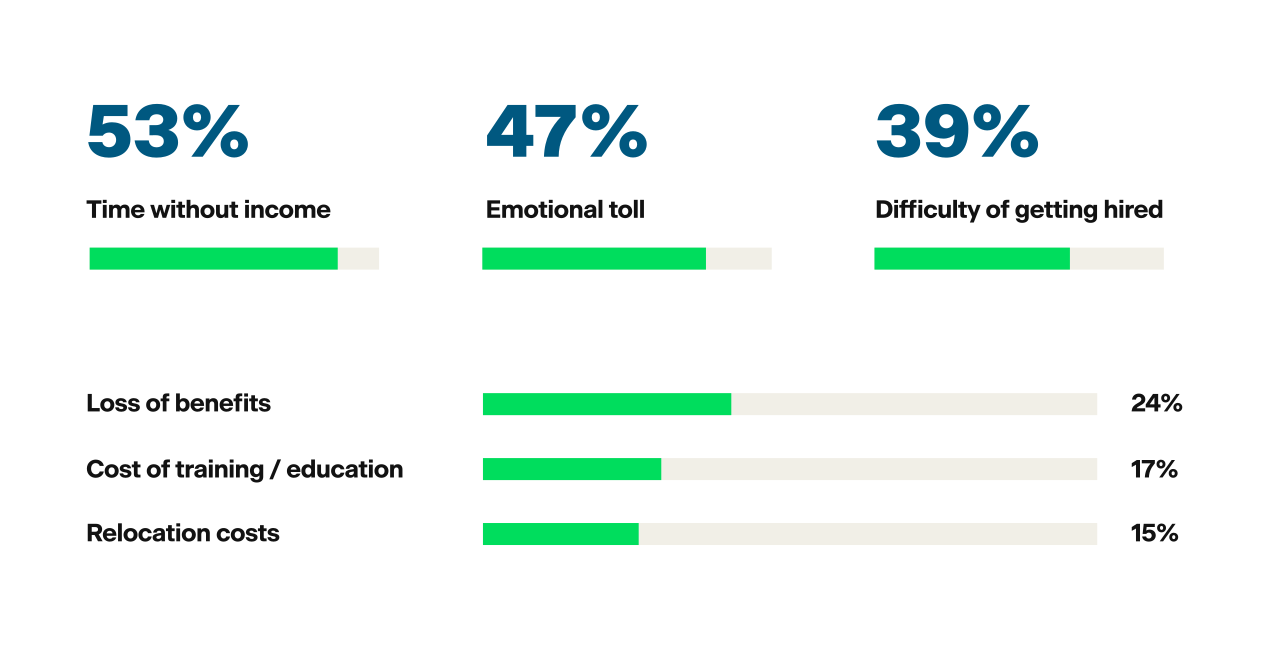
Source: Earnest Research 2026; Base: National survey, U.S. adults 18+ who have changed or are considering changing careers (n=1,508), plus 9 in-depth qualitative interviews. Q26, asked of Passive respondents (n=1,099); multi-select, sums to more than 100%.
Healthcare is a related, often-missed cost in the same category: nearly a quarter of people who changed careers incurred healthcare or insurance costs—one of the most common themes in their own words when describing a "surprising" cost, right up there with lost income itself.
Don't budget yourself out of joy. Set aside a little for dinner out, a hobby, whatever keeps you feeling like you. It's not a treat—it's a real cost, and our data says it's the second-biggest thing people didn't see coming.
That distinction—a cost you can budget for vs. a cost you can only absorb—comes up one more time in this report, in a place people don't expect it: the newest, strangest bill of all, arriving every month whether the job is safe or not.
"Food and rent were the big ones, but I wasn't stressed out about it… where I was stressed was having to feel bad about wanting to spend my own money to enjoy my life."
AI: the push, the destination, and the new monthly bill
AI is pushing people out of careers, and charging them to keep up with the next one
That's not a complaint about AI taking a job. It's a complaint about AI sending a bill. Two different things, and our data shows both are real.
40.8% of respondents say AI or automation had some or a significant influence on their decision to change careers—and, as we saw in Section 1, when people do name AI as a motivator, they're nearly twice as likely to rank it their #1 reason (24%) as the simple selection rate (13%) alone would suggest. When AI matters, it tends to matter most.
AI: the push, the destination, and the new monthly bill
AI is pushing people out of careers, and charging them to keep up with the next one
That's not a complaint about AI taking a job. It's a complaint about AI sending a bill. Two different things, and our data shows both are real.
40.8% of respondents say AI or automation had some or a significant influence on their decision to change careers—and, as we saw in Section 1, when people do name AI as a motivator, they're nearly twice as likely to rank it their #1 reason (24%) as the simple selection rate (13%) alone would suggest. When AI matters, it tends to matter most.

Base for 41%: Respondents whose career decision was influenced by AI (n=615). 32% figure based on all respondents (n=1,508).
AI tools themselves are becoming a new, recurring cost of staying employable. Subscriptions and credits that didn't exist as a line item in most people's budgets five years ago now show up every month, whether the job is safe or not.
Put the three roles together and AI stops looking like a single threat and starts looking like something closer to a tax on staying employed at all—a push that ends one career, a compass pointing toward the next one, and now a subscription fee for keeping up with either.
"I did not expect that it takes credits to use AI tools… you have to keep paying these tools… almost like paying a worker, but it's AI."
"I'm trying to AI-proof my career a little bit."
Conclusion
The rat race isn't going anywhere, but maybe you can find a better lane
Changing careers has never been priced accurately, and our research shows why: the number people budget for—tuition, a certification, new equipment—isn't the number that actually determines how hard the transition is. The real cost is a length of time: how long you'll go without a full paycheck. And almost everyone, including people actively planning a change right now, underestimates it.
That reframes the whole decision. People ask themselves "what will this cost me?" when the more useful question is "how long can I go without full income, and what happens if it's longer than I think?" People who avoid an unplanned gap almost always did it on purpose. People who fall into unplanned gaps are the ones who end up furthest from where they expected to be.
None of this makes career changes a bad bet. Most people would make the same choice again, even at a financial loss. 69% say it was financially worth it, and 75% say they're happier. This isn't a story about risk to be avoided. It's a story about risk that's currently mis-priced.
"I'm happy with my decision to change careers. I made more money, it was more flexible. It certainly isn't glamorous but it works for me."
How Earnest can help
At Earnest, we believe ambitious professionals shouldn't have to choose between playing it safe and living the life they envisioned. You can't control whether your industry changes, whether your next job search takes three months or six, or exactly what AI will mean for your career five years from now. But you can give yourself more room to move.
That starts with understanding what you can control: how much cash you have available, how much money has to go out every month, what borrowing will actually cost you, and which expenses you can reduce before your income changes.
Build the runway before you need it. An emergency fund isn't particularly exciting when everything is going well, but you’ll be thankful to have one built up if the paychecks stop. Before making a voluntary career change, look beyond the obvious price tag and think about the months when your income could be lower (or nonexistent). Our research suggests that's the part people are most likely to underestimate.
Make your existing debt take up less room. If student loan payments are eating into the money you'd otherwise be saving, refinancing, opens in a new tab1 could potentially lower your interest rate or monthly payment2 depending on the terms you qualify for. That can mean more room in the monthly budget to build savings before a transition. For the meaningful share of people financing a pivot through additional schooling or certification, refinancing existing student debt could lower the monthly obligation during the specific window when income is lowest.
Replace reactive credit-card debt with planned financing. More than a third of career changers in our survey took on debt, and among those who borrowed, credit cards were the most common choice. When borrowing is necessary, compare the full cost and repayment terms of your options rather than automatically reaching for what's already in your wallet. Depending on your credit profile and the terms available to you, a fixed-rate personal loan may be worth comparing with carrying a credit card balance. A personal loan, opens in a new tab taken deliberately, before the gap, with a fixed rate and a clear payoff timeline, is a fundamentally different financial position than a credit card balance accumulated mid-crisis.
Maybe you're one of the people who gets to choose exactly when to make the leap. Maybe life makes the choice for you. Either way, the more financial room you have, the more time you have to figure out what comes next—and the less likely you are to have to make the next decision because the money ran out.

Disclaimer: The opinions expressed by interview subjects are not necessarily those of Earnest. Interview participants were compensated for their time. This report provides personal finance educational information and is not intended to provide legal, financial, or tax advice.
1 Please note that you will lose benefits associated with your underlying federal loans, such as federal Income-driven Repayment Plans, Economic Hardship Deferment, Public Service Loan Forgiveness, or other deferment and forbearance options, if you refinance into a private loan. If you file for bankruptcy, you may still be required to pay back this loan.
2 Choosing to refinance to a longer term may lower your monthly payment, but increase the amount of interest you may pay. Choosing to refinance to a shorter term may increase your monthly payment, but lower the amount of interest you may pay. Review your loan documentation for the total cost of your refinanced loan.